
Enterprise AI tools are not ready for SMEs, not just because of price, but because of product philosophy. Europe's 25 million small businesses need workflow-native AI.
Consider the following scenario
A medium-sized textile company from León with 20 employees that supplies clothing to small boutiques and retailers nationwide. Owner Sofie wakes up every morning and thinks: how many orders will she get, which shipments are delayed, which customer emails are not answered. Her competitor, a big fashion enterprise, has automated all of this with AI. Sofie also wants AI. But the AI tools available in the market are primarily built with large enterprises in mind - their sales pipeline, their data team, IT team. Sofie doesn't have these. This story summarizes Europe's biggest AI crisis.
The Backbone
Europe's backbone: 26.1 million SME
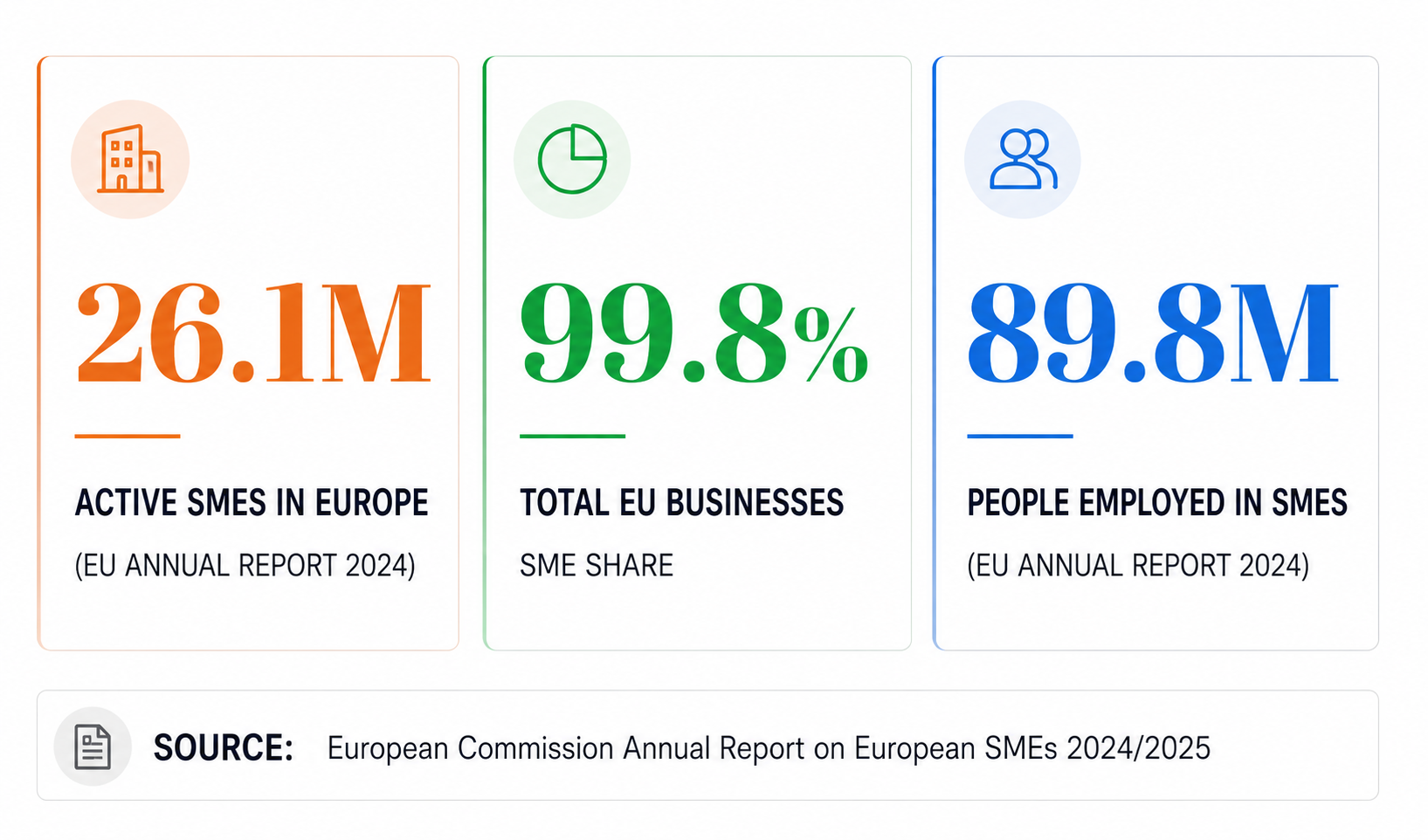
According to the European Commission's Annual Report, in 2024, SMEs were a cornerstone of the European Union's (EU) economy, comprising 99.8% of all enterprises in the non-financial business sector. With a total of 26.1 million SMEs providing employment to 89.8 million people.
Germany's Mittelstand, France's artisan entrepreneurs, Italy's family owned factories, Poland's entrepreneurs, Spain's family restaurant chains, these people are the lifeline of the European economy. They are not just big in number but they are part of Europe's cultural and economic identity.
But this lifeline is now falling behind in the AI era. This gap isn't driven by choice; it's driven by the way today's AI ecosystem is structured.
The data gap
Division By Number: Digital Discrimination of AI
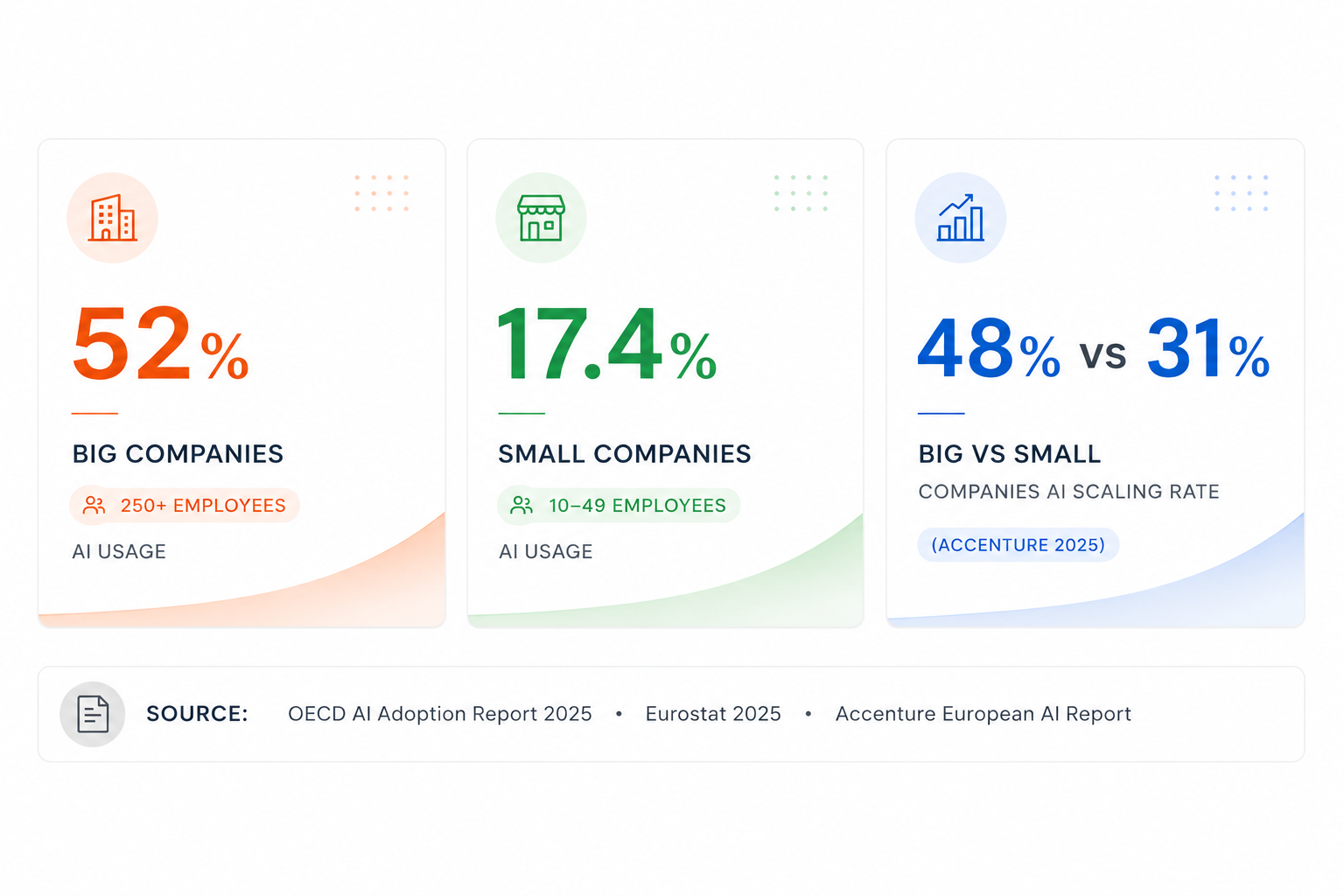
According to Eurostat in 2025, only 20% of EU companies with 10 or more employees used some kind of AI tools. In 2024, this was 13.5% while this has increased but not at a rapid pace.
According to OECD 2025 report, these discrepancies are more clear:
|
Based on Eurostat and OECD data |
The Real Barriers
Not Pricing, Philosophy: CRM first vs Workflow-native
Honestly speaking, Salesforce's Starter Suite which is $25/user/month gives significant AI capabilities like Agentforce conversational AI assistant, Einstein Conversation Intelligence which creates video call transcripts and summaries, automated sales flow, and marketing automation. No IT setup required. So where's the problem?
Problem isn't pricing, it's product philosophy. Salesforce is mainly a CRM company. The center of their full product architecture is customer relationship management contacts, pipelines, deals. AI is placed on top of this. This isn't Salesforce's fault, it's just how they operate.
But Italy's 12 person manufacturing company owner doesn't wake up thinking, "How's my CRM pipeline?" He thinks: Who will create today's invoice? Who will respond to customer complaints? Why is the shipment delayed? His problems start not from CRM but from daily operational workflow. These two different questions cannot be answered by the same product.
Two different starting points:
| CRM-centric platform - Customer relationship management - Sales pipeline tracking - AI layered on top of CRM data - Designed for defined sales teams |
SME's real needs - Help with today's tasks, right now - Invoice, email, delivery, customer reply - No separate platform required - Works without an IT team |
Salesforce Starter Suite expands Salesforce's offering for SMEs. While its CRM-first approach solves important customer management needs, many SME owners are focused on a broader set of operational challenges, leaving room for a different kind of solution.
The Deeper Problem
Five Structural Barriers That Really Block The Way
GDPR and the EU AI Act together create a compliance burden that large companies absorb easily. SMEs cannot.
IBM's 2025 EMEA survey found that 72% of large companies increased productivity from AI, but for SMEs, that number was only 55%. Tools are available but SMEs lag in the ability to use them effectively.
The Need
What SMEs Actually Need
World Economic Forum says: "SMEs in particular benefit from ready to use, plug and play AI tools that integrate into existing systems without requiring deep technical expertise."
OECD's report also gives an important insight: SMEs that have used generative AI reported that 39% found it helped fill skill gaps. This means that with the right tools, SMEs can use them effectively and gain benefits.
SMEs demand is actually quite specific:
- Affordable pricing: Effective tools in the $10–$30 per user per month range, not large enterprise suites.
- Easy interface: Usable without an AI engineer so that a restaurant owner or an accountant can set it up themselves.
- Specific solutions: Invoice processing, customer support, inventory management, HR automation - to the point AI tools for specific work.
- GDPR compliant and EU AI Act aligned: Built to comply with European regulations, so SMEs don't have to bear the compliance burden separately.
- Multilingual capabilities: German, French, Polish, Italian - effective in a variety of European languages.
The Opportunity
The Opportunity is Massive, But Largely Untapped
According to Accenture's research, european workers in comparison to american ones are only 76% productive and the major reason for this gap is lower investment in technology. According to European Central Bank's analysis, If AI is successfully adopted, the EU could see an average 4% increase in productivity.
According to WEF's calculation, AI could add $15.7 trillion to the global economy by 2030, with nearly half of this coming from productivity gains. Excluding European SMEs from this opportunity would mean sidelining the economic future of an entire continent.
The European Commission has recognized this. The Apply AI Strategy, launched in October 2025, specifically aims to increase AI adoption among SMEs. Plans are also underway to provide startups and SMEs with free GPU capacity through EU funded AI Factories and EuroHPC supercomputers. In September 2025, Latvian SME Tilde used this opportunity to create a 30 billion parameter open source language model on the EuroHPC LUMI supercomputer.
In my opinion, after looking deeply into the challenges European SMEs face:
“Need products that are built with SMEs in mind from the start where pricing is affordable, setup is easy, and the user is a human being who is not an AI engineer. The real solution for SMEs is AI-native tools. ”
Conclusion
Two-speed AI won't work in Europe
History shows that every major technological shift follows a pattern first, large companies benefit, then the technology becomes democratic. This has happened with the internet, cloud computing, smartphones, everything.
But in the case of AI, this democratization won't happen automatically. Salesforce has entered the SME market but with a CRM first philosophy. Microsoft Copilot has arrived but within the Office suite. These are not products made for SMEs; they are smaller versions of enterprise products. Even government initiatives alone are not enough.
The biggest change will come when entrepreneurs and investors consciously start building AI-native tools for SMEs, when products are designed with the needs of SMEs in mind, not with a $10 million enterprise client in mind.
For Europe's 25 million SMEs, AI is no longer a luxury, it's a question of competitive survival. Those who seize this opportunity will not just build a company; they will help shape the economic future of a continent.



.png?width=110&height=79&name=glassdoor%20(1).png)