
Your regression suite takes three hours to run. It passes all the test cases, you sign off on the feature, and you happily leave the office.
Then at 2 AM your phone buzzes, a Slack message from your manager: a bug shipped anyway and broke production. If that sounds familiar, the suite is not the problem. The model underneath it is.
Back when Selenium IDE was still a Firefox plugin and you recorded a test by clicking through the browser and praying the XPath held, QA ran on a comfortable kind of logic: write the tests, run them, trust the green checkmark.
And the tools genuinely kept getting better. We moved to Selenium WebDriver and Grid, fought the flaky waits and the Thread.sleep(5000) hacks, then Cypress showed up feeling faster and friendlier, and then Playwright quietly fixed the thing we'd been hacking around for a decade. No more sprinkling sleeps everywhere.
One await page.click('#submit') waits for the element to exist, be visible, stop moving, and actually be clickable before it touches it, with that smart waiting built in globally and per action instead of bolted on by hand. Throw in real cross-browser support and parallel runs that didn't fall over, and it honestly felt like the future.
Every one of those upgrades was real. But here's the thing they all had in common: they got better and better at running scripts a human wrote ahead of time. And the bugs that wake you up at 2 AM are exactly the ones nobody thought to script. That's the gap. And it's the gap AI is built to close.
Teams that cling to one tool always end up a step behind, because something better is always coming. AI in QA testing is that next step, and no, it isn't hype. It's a real change in how teams think about software quality, and the same old rule still applies: adapt, or get left behind.
Key Takeaways
- AI in QA testing changes three core areas: test generation, coverage analysis, and regression detection.
- Both automation and manual QA benefit. AI can generate test cases from PRDs, SRS documents, and PR descriptions in minutes.
- Traditional QA is breaking under faster releases, distributed systems, and flaky automation.
- AI works best across the whole SDLC, not as a bolt-on at the end.
- QA engineers are not being replaced. Their role is shifting toward strategy, curation, and exploratory work.
- Tools alone will not save you. Curation, trust-building, and integration matter as much as the AI itself.
Why the Old QA Playbook is Breaking
Releases used to be a thing you planned around. Now they just sort of happen in the background. You glance at the deployment queue and there are 15 PRs sitting in "ready for deploy." You go make a coffee, come back maybe an hour later, and somehow it's 30. And you kind of just stare at it for a second, like, how is the team shipping this fast?
Then it hits you: half the devs are pairing with AI now, and they're flying. Code gets written, reviewed quicker than it ever used to. Which is amazing if you're the one shipping. If you're QA, it's a nightmare.
Throw in microservices, a pile of distributed systems, and a frontend that gets redesigned every other sprint, and the ground you have to cover doesn't just grow, it blows wide open. The old way of doing things, one human reading every change and writing tests to match, was already hanging on by a thread. Now it's gone.
The thing is the old automation just can't keep up with that pace, and honestly, most of us already know it. A Selenium script breaks because somebody nudged a button five pixels to the left. Tests get so flaky that the team quietly stops trusting failures at all, and that's exactly how a real bug sneaks through, hiding in plain sight among all the false alarms.
Meanwhile the coverage report sits there proudly telling you 80% of your lines ran, and says absolutely nothing about whether any of it actually checked the right thing. We've all seen a pipeline go green, breathed a sigh of relief, and then watched a nasty bug stroll straight into production an hour later. That gap, the space between "the tests passed" and "the software actually works," is exactly where AI earns its place.
Here's the part that actually saves you: AI isn't just the thing drowning you in PRs, it's also the thing that pulls you back out. Picture a normal Monday. A dev drops a new feature on you, two happy-path tests bolted on, a cheerful "yeah, should be fine." You know that feeling in your gut. It's never fine. Normally you'd burn the whole afternoon reading the diff, sketching out everything that could go wrong, then writing the automation by hand.
Not anymore. You throw the entire change at an AI tool and tell it, plainly, "here's the code, here's what we already cover, now write me tests for everything we don't." Two minutes. That's it. And it hands you back the stuff that actually keeps you up at night, the empty input, the session that expired three screens ago, the payment API that dies halfway through, the user who slams submit twice because the spinner lagged. All the ugly little edges you swore you'd get to, and never did, because there's only one of you and thirty PRs in the queue.
You skim them, kill the noise, keep the sharp ones, fix a line or two, and just like that the coverage on that feature jumped in twenty minutes instead of half a day. You stopped being the person typing every test from scratch. You became the one deciding which ones matter. That's not a small shift. That's the whole job changing under you.
Three Ways AI in QA Testing is Rewriting the Rules
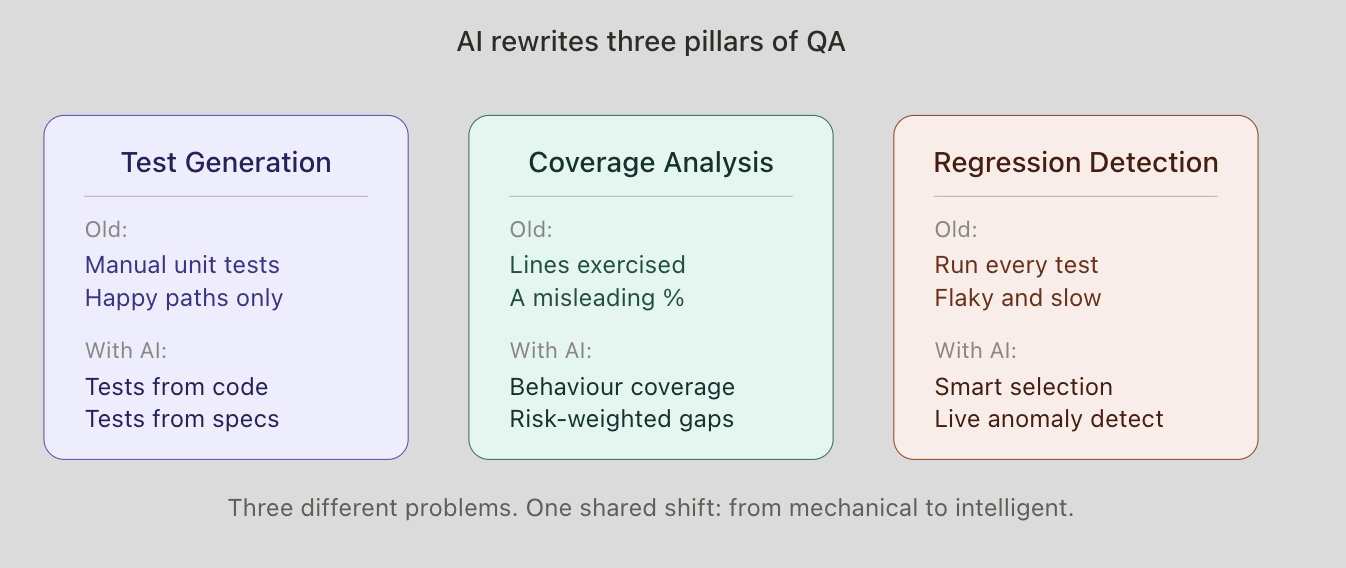
AI changes three things in particular, and once you see how, the case for rethinking your strategy becomes hard to argue with.
1. AI Test Generation
Writing tests by hand is slow, error prone and biased. You write a function, then you write three or four tests for the cases you already had in your head, the happy path and maybe one obvious edge. But the bugs that take down production are never in those cases. They're in the scenarios nobody thought of, which is the whole reason nobody wrote a test for them.
AI test generation breaks through that ceiling in a few ways:
There's a catch, of course. AI will cheerfully hand you a hundred tests when ten would've done the job, and if you let it, you'll drown in noise. So curation is the new core skill, for hand-written test cases just as much as automated ones.
2. Coverage Analysis Powered by AI
Ninety percent line coverage might be the most comforting lie in software. It doesn't mean 90% of your software is tested. It means 90% of your lines ran, maybe by tests that assert nothing more useful than "well, it didn't crash." We've all shipped a suite that glowed green and still had a production-breaking bug sitting right there in plain sight.
AI changes coverage analysis in three big ways:
- Behavioural coverage maps your tests to the flows people actually take, not just the lines your code happened to run. It answers the question you actually care about, "is the stuff users do every day actually tested?", instead of the vanity-metric.
- Risk-weighted coverage looks at your code churn, your defect history, and how the app gets used, then points at the spots where thin coverage is genuinely scary. Your checkout and payment flow isn't the footer link to your privacy policy, and your coverage strategy should treat them differently.
- Gap detection from production data holds real user behaviour up next to your test suite and tells you, flat out, what thousands of people do every day that not one test touches. Finding that by hand used to mean days of detective work. Now it's just a report you read.
3. AI-Powered Regression Detection
Regression is where QA time goes to die. The same suite, run over and over, most of it having nothing to do with what actually changed. AI takes a scalpel to it:
AI Across the Full SDLC
If you treat AI as something that only lives in the testing phase, you're leaving most of its value on the table. The real payoff shows up when it runs through the whole lifecycle.
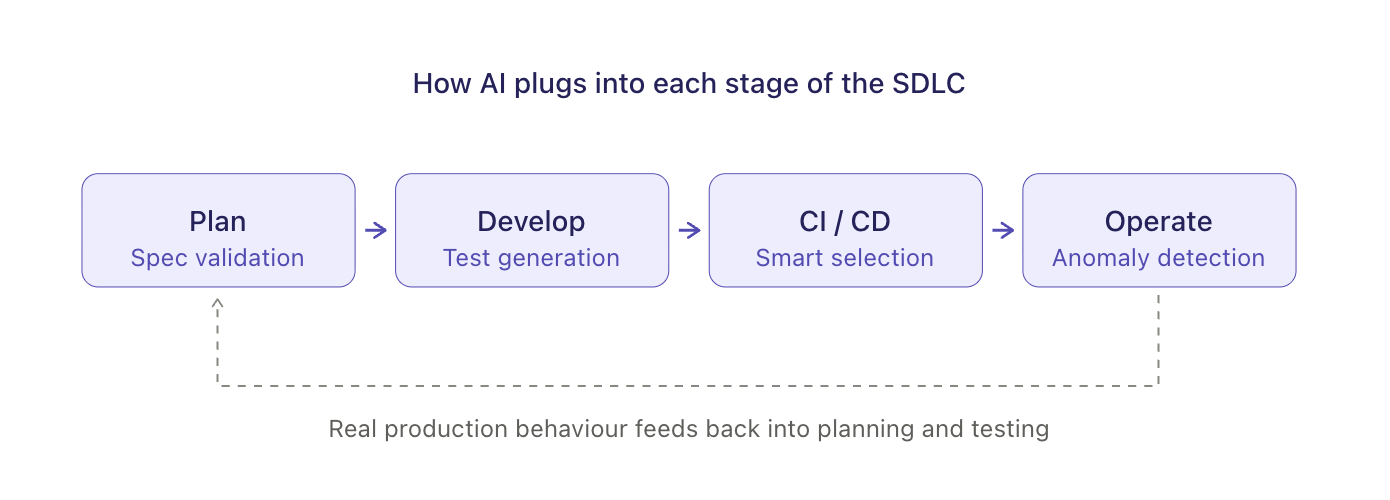
Planning: Think about how many bugs are really just a vague sentence in a ticket that nobody questioned. AI reads through your user stories and actually catches that stuff, the acceptance criteria that's missing, the requirement that quietly contradicts the one three lines up, the "the system should handle errors gracefully" that means nothing and everyone nodded at anyway. It kills those defects while they're still just sloppy writing, before anyone's burned a day building the wrong thing.
Development: Here's the part that quietly changes everything. AI pair-programming assistants write the tests right next to the code, in the same breath you write the feature. Remember TDD? Everyone swore it was the right way to work, and then almost everyone abandoned it, because honestly, who has time to write the test first when you're staring down a deadline? That excuse is gone now. The test shows up as fast as the code does. The thing we all felt guilty about skipping suddenly costs you nothing.
CI / CD: You know that pipeline. The one you kick off, then go get coffee, answer three Slacks, and check back, and it's still chugging. Smart test selection plus parallel execution takes that 90-minute slog and hands you a result before your cup's even full. The feedback loop that used to break your focus for an hour now barely interrupts you.
Operate: This is where the whole thing closes the loop and gets a little bit magic. Real production behaviour, what users actually do, where things actually break, feeds straight back into your test suite. So your suite stops being that fossil sitting in the repo that everyone's scared to touch, and starts being something alive, something that learns what's breaking in the real world and watches for it next time.
Wire all of that together and something clicks. QA stops being a gate at the end, the bottleneck you shove finished work through and pray it passes. It becomes a current running underneath everything, quiet, constant, always on. Not the thing that slows you down before release. The thing that lets you move fast without flying blind.
The Honest Limitations of AI in Software Testing
It'd be easy, and a little dishonest, to sell you AI in QA as all upside. It isn't.
- AI makes noise. Turn it loose without curation and it floods your suite with redundant tests, slows your CI to a crawl, and creates more maintenance than it ever saved. Garbage in, a thousand tests of garbage out.
- Trust has to be earned. When AI tells you coverage is solid, you need to be able to bet a release on it. That kind of confidence comes from verification, not vibes, and it takes time to build.
- The skill shifts, it doesn't disappear. AI has no clue what a furious user does at midnight on hotel wifi with a dying battery. Human intuition, empathy, and plain old suspicion are still what catch the worst bugs.
- It isn't free. Budget, training, integration, the bill is real. This is an investment, not a magic wand.
So be ruthless with any vendor who promises AI will replace your QA team. They're selling you a fantasy. The truth is messier and a lot more interesting: AI makes good QA people dangerous, not redundant.
Conclusion
The QA strategy that carried you through the last five years won't carry you through the next five. AI in QA testing isn't a plugin you bolt onto the old process so you can call it modernised. It's a reason to ask a harder question: what is QA actually for, and where should it live?
So stop treating testing as a gate at the end of the line, the thing that says yes or no once the real work is already done. Start treating it as a continuous, AI-augmented current that runs from the first user story all the way to the last production deploy.
Teams that make that shift now will ship better software faster, with leaner QA teams doing sharper, more interesting work. Teams that don't will keep getting that 2 AM Slack message and keep wondering why.
You already know how this story ends. Selenium gave way to Cypress, Cypress gave way to Playwright, and the teams that clung to the old tool spent years explaining why they were slower than everyone else. AI is just the next turn of that same wheel.
The only question left is whether your strategy turns with it, or ends up doing the explaining.



.png?width=110&height=79&name=glassdoor%20(1).png)